- 中文
- English
- Español
How to use the 10x magnifying glass To Check Diamonds
2023-03-12 09:41:43
Click:
“
The 10x magnifying glass is one of the most commonly used and important tools fo
”
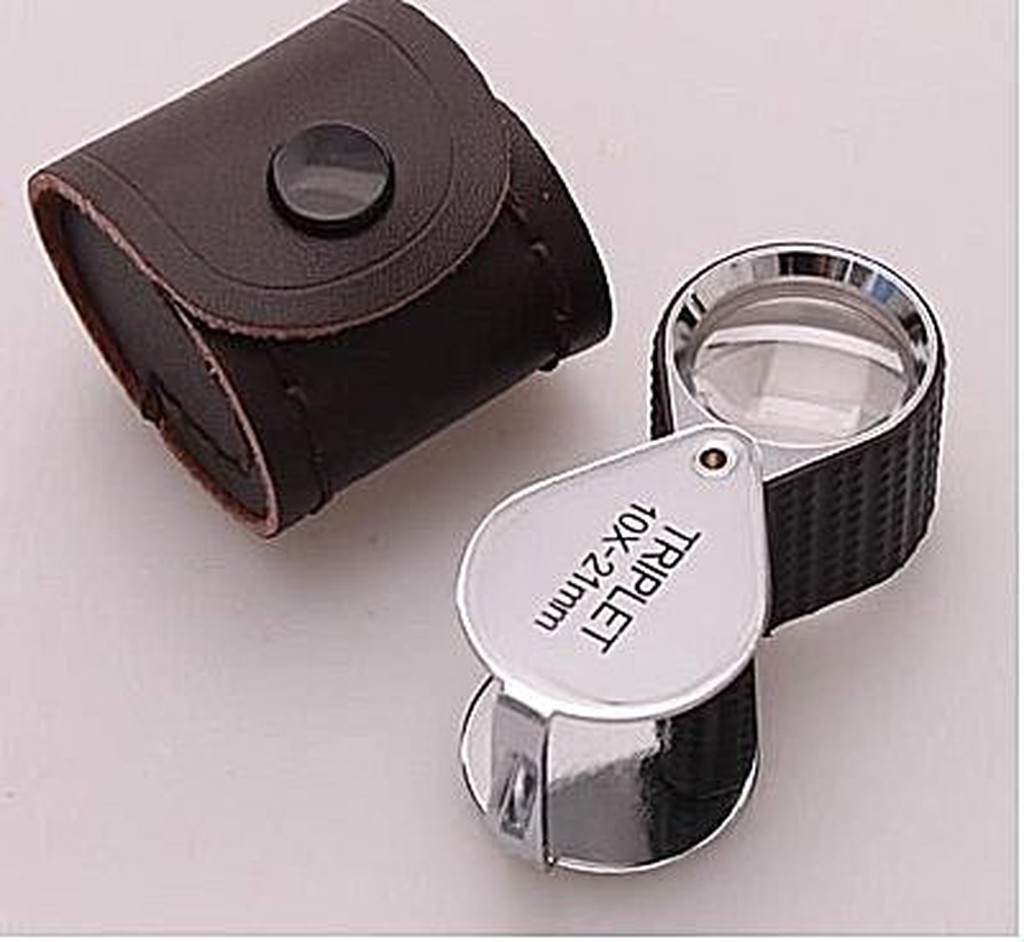
The 10x magnifying glass is one of the most commonly used and important tools for diamond grading. In jewelry identification and diamond grading, the qualified magnifying glass used is made of a combination of three lenses to eliminate aberrations and chromatic aberrations, and at the same time have the effect of large observation field.
Aberration is a phenomenon in which an object is distorted after being magnified by a magnifying glass, that is, all points on the same observation plane cannot be focused at the same time. The aberration at the center of the field of view of the magnifying glass is smaller than that at the edge.
Chromatic aberration is caused by the inconsistency of the focal length of the lens for different wavelengths of colored light, that is to say, the magnifying glass cannot focus light of different wavelengths on the same plane, and the edge of the object image is prone to dispersion effect, forming chromatic aberration. As with aberrations, chromatic aberration is less near the center of the field of view than at the edges. Chromatic aberration reduces the sharpness of the magnifying glass image. If within the field of view of the magnifying glass, the larger the range without aberrations and chromatic aberrations, the easier it is to observe, which also means that the chromatic aberrations and aberrations are relatively small.
The magnifying glass has a large field of view and good quality. In order to eliminate aberrations and chromatic aberrations, the magnifying glass used for jewelry testing and diamond grading is to clamp and bond two concave-convex lenses made of lead glass and a double-convex lens made of lead-free glass, which is called a "triple" mirror. This magnifying glass has no aberration and chromatic aberration.
The way to check the quality of the magnifying glass is to use a magnifying glass to observe a small grid pattern of 1mmx1mm size, such as coordinate paper. If the small grid image is not distorted and there is no chromatic aberration around it, its quality is qualified.
In addition, magnifying glasses used for diamond grading should have white, black, or gray casings so as not to interfere with the correct judgment of color when grading diamonds. Although color grading is done in comparison to master stones, viewing under a loupe leaves an impression of the diamond's color.
Pay attention to the following issues when using a magnifying glass.
①The correct method is to hold a magnifying glass in one hand, put the metal coat of the magnifying glass on the index finger or middle finger, and hold the diamond with tweezers in the other hand. The magnifying glass is close to the eyes, and the distance is about 2.5cm. The sample is close to the magnifying glass, and the distance is also about 2.5cm. .
② The elbows naturally droop to support the table, the body remains stable, and the hands holding the magnifying glass and tweezers are pressed against each other to maintain the stability of the mirror and the diamond sample. According to the observation requirements and effects, slightly adjust the position of the diamond and the magnifying glass, so that the observation point is in the quasi-focus position, so as to form a clear observation image.
③ When observing diamonds, open your eyes naturally, avoid opening and closing to prevent eye fatigue.









-

Foshan Highlight Intelligent Technology invites you to the 140th Canton Fair—join us at Booth 21.2A23-24 in the Friendship Hall to share in the brilliance.
Foshan Highlight Intelligent Technology invites you to the 140th Canton Fair—join us at Booth 21.2A23-24 in the Friendship Hall to share in the brilliance.
-
CVD Single-Crystal Diamonds: An Analysis of the Complete Processing Workflow from Gas-Phase Deposition to Finished Diamond Chips
MPCVD (Microwave Plasma Chemical Vapor Deposition) technology is currently the core process for producing high-quality single-crystal diamond s. Thanks to its advantages of low defect rates, high purity, and controllable large dimensions, it is widely used in fields such as semiconductor heat dissipation, precision optics, and high-end sensors. The final quality of single-crystal diamond s depends on comprehensive process control throughout the entire workflow—from vapor deposition growth to pos
-
Single-Crystal or Polycrystalline Diamond — Which Has Greater Potential?
As diamond continues to enter industries such as semiconductors, thermal management, optics, high-power electronics, and precision machining, the requirements for diamond materials are also evolving.
-
Diamond Polishing and Grinding Processes: Core Challenges and Industry Hurdles
Diamond is often hailed as the “ultimate material” – ranking 10 on the Mohs hardness scale, boasting an ultra‑high thermal conductivity (~2,200 W/(m·K)), excellent chemical stability, and broad optical transparency. These properties make it irreplaceable in cutting‑edge applications such as semiconductor heat dissipation, high‑end optics, and quantum chips. Yet the paradox of “good materials are hard to process” is nowhere more evident than in diamond. From rough grinding for planarization to at