- 中文
- English
- Español
Got a "diamond"? Can you tell natural diamonds, lab-grown diamonds, cubic zirconia & moissanite apart? This essential guide helps you avoid mistakes!
2025-12-19 16:53:29
Click:
“
Everyone knows that diamonds shouldn't be bought casually; there are too many pitfalls for consumers who have never received any diamond-related education. Many people are misled by merchants into believing "this is a real diamond," when it might actually be cubic zirconia, moissanite, or even they can't distinguish between natural and lab-grown diamonds, spending a lot of money on the wrong thing...
”
Everyone knows that diamonds shouldn't be bought casually; there are too many pitfalls for consumers who have never received any diamond-related education. Many people are misled by merchants into believing “this is a real diamond,” when it might actually be cubic zirconia, moissanite, or even they can't distinguish between natural and lab-grown diamonds, spending a lot of money on the wrong thing...
So what are the differences between natural diamonds and lab-grown diamonds, as well as between cubic zirconia and moissanite? Today, we'll teach you how to distinguish them from four aspects: composition, fire, hardness, and price. Finally, we'll tell you which option offers the best value for money.
Natural diamonds: treasures hidden in the depths of the earth
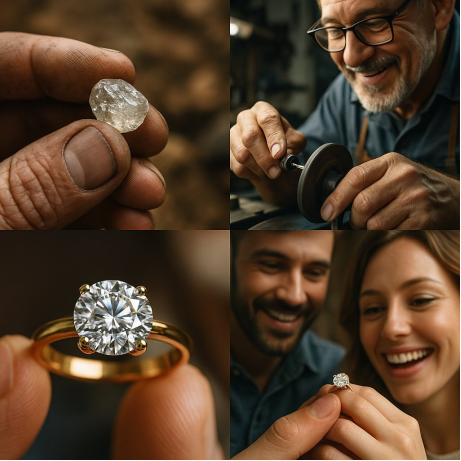
Natural diamonds are pure carbon crystalline minerals naturally formed deep within the Earth, and are the hardest substance in nature. Their formation is a geological marvel spanning millions of years: in the extreme environment of 120-200 kilometers below the Earth's surface, carbon gradually crystallizes under high temperature and pressure (1100-2000 degrees Celsius, 50,000-70,000 atmospheres). Then, propelled by the immense force of volcanic eruptions, it is brought to the surface along with magma from kimberlite or pyrolithic garnet, where it cools and forms diamond-bearing parent rock. With its Mohs hardness of 10, natural diamonds are also imbued with the symbolic meaning of ”steadfastness and eternity.”
Laboratory diamonds: a true miracle of modern technology

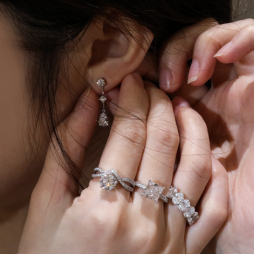
Lab-grown diamonds are created in an environment similar to that of natural diamonds, taking several weeks to grow and form diamonds. Although the growth environment and time required differ, natural and lab-grown diamonds are completely identical in terms of chemical composition, crystal structure, optical and physical properties.
There are two main techniques for creating lab-grown diamonds: HPHT (High Temperature High Pressure) diamonds and CVD (Chemical Vapor Deposition) diamonds. Regardless of the process, the chemical, physical, and optical properties of lab-grown diamonds are identical to those of natural diamonds. Therefore, to distinguish between natural and lab-grown diamonds, it is necessary to have them examined by a professional gemological laboratory using specialized instruments to confirm whether they are 100% natural.
Moissanites: a stellar sparkle at your fingertips
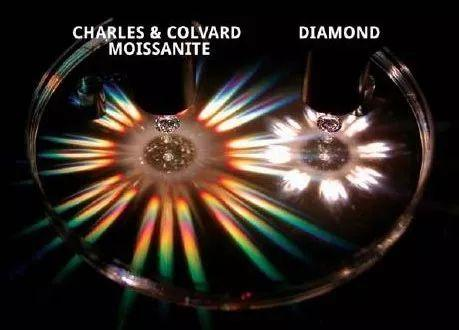
Diamonds are composed solely of carbon, while moissanite contains silicon in addition to carbon. Discovered by French scientist Henri Moissan, moissanite appears to exist near stars in the universe, hence its nickname ”stardust.” This gemstone is extremely rare in nature. Today, jewelers almost exclusively use laboratory-synthesized moissanite, which has become a highly sought-after gemstone due to its properties and similarity to diamonds.
Diamonds have the highest hardness, reaching 10, while moissanite closely follows with a hardness of 9.25, even surpassing rare gemstones like sapphire and ruby. Therefore, moissanite is very durable and suitable for everyday wear. Furthermore, moissanite possesses extremely high luster, 18% higher than diamonds. Under certain conditions, moissanite's reflection exhibits an iridescent effect. This is due to its birefringence; light passing through the gemstone is bent and refracted, splitting into two beams and further decomposing into different spectral colors.
Cubic zirconias and their fading glory
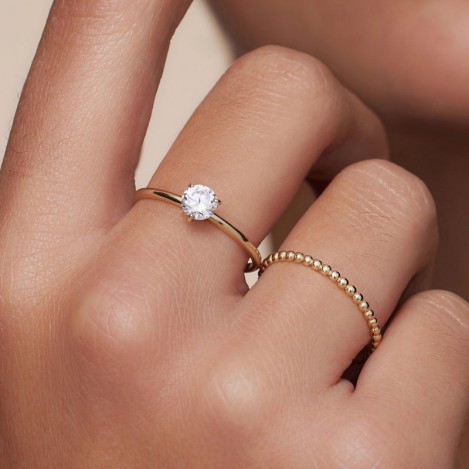
Cubic zirconia is the best diamond simulant to date, and even some jewelers have mistaken it for diamond. Chemically, cubic zirconia is zirconium dioxide, with the chemical formula ZrO₂. It is prized for its high hardness of 8.5 and high refractive index.
In fact, their visual appeal is far inferior to that of diamonds. Due to an optical anomaly known as ”windows,” they often exhibit a glassy texture. These ”windows” refer to transparent areas that do not reflect light, meaning you can look through them as if through a window, or conversely, they can appear as dark areas within the gemstone. This negative effect (known as the ”window effect”) is most noticeable when you view the gemstone from different angles. Another major drawback of zirconium oxide is that it loses its luster over time—becoming cloudy and no longer sparkling.
The following one charts summarize the differences between natural diamonds, lab-grown diamonds, moissanite, and cubic zirconia:

A comparison reveals that while cubic zirconia and moissanite are inexpensive, their hardness and brilliance are significantly inferior to diamonds, and they are prone to wear and tear with prolonged wear. Natural diamonds, due to their rarity and their indestructible nature, which is almost as old as the Earth, are considered the only true testament to love.
However, in recent years, the environmental problems and resource scarcity caused by diamond mining have made us increasingly aware of the importance of protecting the Earth's environment. Therefore,“ KF deer ”has built its own factory and laboratory focusing on high-quality lab-grown diamonds using CVD technology, covering a full range of products including loose diamonds, diamond rings, diamond bracelets, necklaces, and earrings. All products come with authoritative testing certificates. Our lab-grown diamonds have the same composition as natural diamonds, conveying the same noble and unwavering love as natural diamonds, giving those who value sustainability another option and allowing them to experience value beyond eternity!
“KF deer” offers a wide variety of diamond ring styles to suit different occasions, as well as customization services. If you would like to learn more about lab-grown diamond styles, prices, or need professional diamond purchasing advice, please feel free to message us. We will be sharing more lab-grown diamond information and best-selling products with you in the future!
High Light Intelligence Technology, a pioneer in the CVD diamond industry, has advanced MPCVD technology and CVD diamond production workshops. We focus on producing high-purity lab-grown diamonds for the jewelry industry, and at the same time create industrial-grade CVD diamond products, covering single crystals, polycrystalline, films and diamond surface metallization and so on. We also provide 6kw/10kw/15kw MPCVD equipment to help customers in all aspects, from equipment to products, and then to all-round services, to create brilliance together.
*The articles and pictures are only for industry communication and sharing. If there is any infringement, please contact us to delete them.









-

CVD Single-Crystal Diamonds: An Analysis of the Complete Processing Workflow from Gas-Phase Deposition to Finished Diamond Chips
MPCVD (Microwave Plasma Chemical Vapor Deposition) technology is currently the core process for producing high-quality single-crystal diamond s. Thanks to its advantages of low defect rates, high purity, and controllable large dimensions, it is widely used in fields such as semiconductor heat dissipation, precision optics, and high-end sensors. The final quality of single-crystal diamond s depends on comprehensive process control throughout the entire workflow—from vapor deposition growth to pos
-
Single-Crystal or Polycrystalline Diamond — Which Has Greater Potential?
As diamond continues to enter industries such as semiconductors, thermal management, optics, high-power electronics, and precision machining, the requirements for diamond materials are also evolving.
-
Diamond Polishing and Grinding Processes: Core Challenges and Industry Hurdles
Diamond is often hailed as the “ultimate material” – ranking 10 on the Mohs hardness scale, boasting an ultra‑high thermal conductivity (~2,200 W/(m·K)), excellent chemical stability, and broad optical transparency. These properties make it irreplaceable in cutting‑edge applications such as semiconductor heat dissipation, high‑end optics, and quantum chips. Yet the paradox of “good materials are hard to process” is nowhere more evident than in diamond. From rough grinding for planarization to at
-
Single-Crystal vs Polycrystalline CVD Diamond: Process Difference Lies in Growth Logic, Not Equipment
The process difference between single crystal and polycrystalline CVD diamond lies not in equipment, but in growth logic. Single crystal and polycrystalline CVD diamond are two functional new materials with completely independent growth mechanisms, lattice structures and performance systems. Their process logic, product features and application boundaries diverge fundamentally from the very start of deposition and growth. Comparing or selecting materials without considering their underlying crys