- 中文
- English
- Español
Where is the development direction of diamond homoepitaxial growth technology? Kanazawa University in Japan provides the answer with its research on excellent growth rate
2024-09-13 09:04:59
Click:
“
Strong covalent bonds endow diamond with excellent properties, such as high thermal conductivity, high mobility and wide bandgap, making it a candidate material for power devices, optoelectronics, quantum technology and sensors. However, practical applications still face challenges, such as MPCVD process control to achieve large size, smooth surface and conductivity requirements, as well as the improvement of traditional processing technology. This article outlines three MPCVD growth technology
”
01
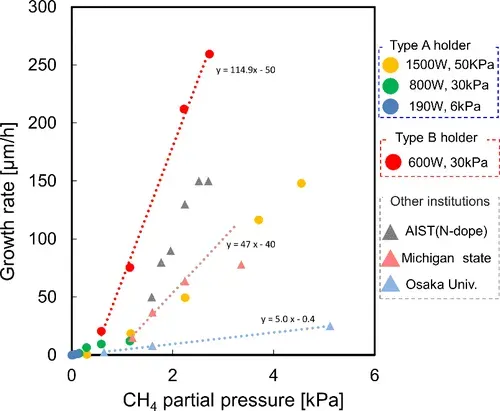
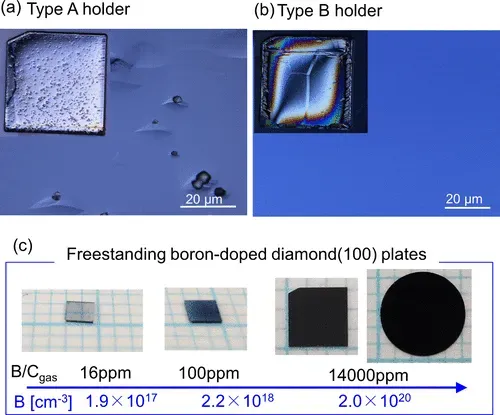
The paper introduces the technology of diamond sheet growth rate enhancement. By optimizing the reactor, electric field, gas and substrate positioning of MPCVD, a high growth rate of 250 μm/h and excellent crystal quality are achieved without nitrogen. After adding nitrogen and optimizing the conditions, the rate is increased to 432 μm/h. This technology produces 0.1mm thick independent diamond plates with crystallinity comparable to HPHT substrates and better than commercial CVD substrates. X-ray diffraction verifies its high quality. However, the application of large-area substrates is still a technical difficulty.
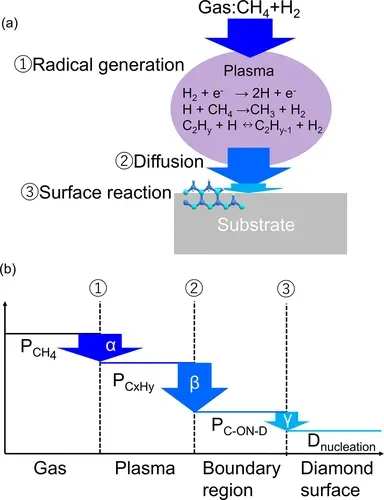
Key points of diamond CVD growth: Free radicals are generated by microwave excitation of hydrogen-methane mixture; hydrogen atoms promote the preservation of active substances. Active substances diffuse from plasma to substrate, collide on the way to generate new substances, and interact with the diamond surface through the sheath. During the surface reaction, active substances migrate to the reaction site to form chemical bonds or desorb, hydrogen atoms etch SP2 bonds, and hydrocarbons promote diamond growth. The study used CVD equipment and support structure to explore the growth rate of (100) diamond film as a function of methane partial pressure, and found that increasing microwave power and total pressure can increase the growth rate, up to 150μm/h. High power density may improve methane conversion efficiency, but the growth rate slope is equivalent to that under nitrogen-free conditions, which may be attributed to the low diffusion efficiency of carbon free radicals.
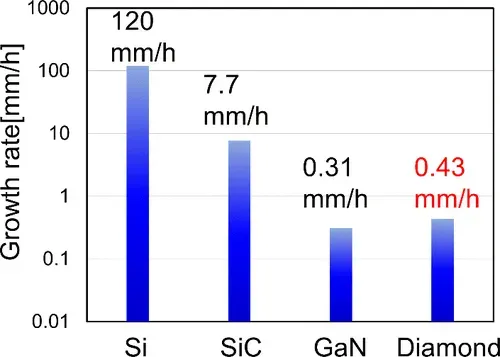
The research report pointed out that the project has achieved the fastest growth rate in the world. Compared with power semiconductor materials such as Si, SiC and GaN, the growth rate of diamond is lower than that of commercial Si and SiC, but it is comparable to GaN. The biggest challenge is to expand the area of diamond seeds. Heteroepitaxial growth is difficult to reach a large size, and homoepitaxial growth can be three-dimensional or mosaic growth. The team's technology has been successfully tested on a small substrate and is suitable for the latter. MPCVD requires three-dimensional expansion of the plasma ball to increase the area, but reduces the power density and limits the growth rate over a large area. Although 915 MHz microwaves increase the area, they reduce power utilization and material supply efficiency. The solution lies in two-dimensional expansion of plasma to increase power density, and explore hot filament CVD and plasma-free gas CVD to reduce the energy cost of diamond production.
02
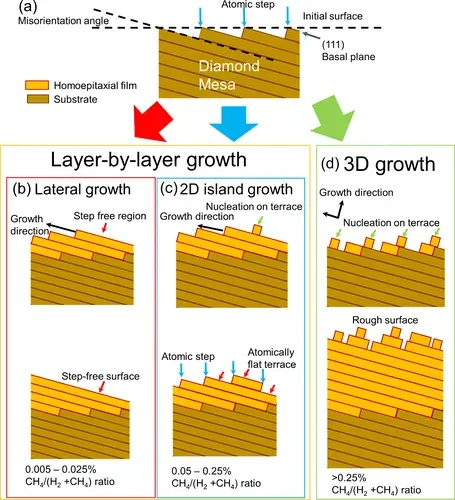
The researchers manipulated the diamond surface at the atomic level by adjusting the growth mode. On the homoepitaxial (111) surface, lateral, two-dimensional island and three-dimensional growth modes were used. By finely controlling the methane concentration and substrate misalignment, the growth mode can be switched on the high-pressure and high-temperature (111) table. The lateral growth was extended from microns to millimeters. After optimization, the researchers achieved an atomically flat diamond surface on the entire substrate.
03









-

Single-Crystal vs Polycrystalline CVD Diamond: Process Difference Lies in Growth Logic, Not Equipment
The process difference between single crystal and polycrystalline CVD diamond lies not in equipment, but in growth logic. Single crystal and polycrystalline CVD diamond are two functional new materials with completely independent growth mechanisms, lattice structures and performance systems. Their process logic, product features and application boundaries diverge fundamentally from the very start of deposition and growth. Comparing or selecting materials without considering their underlying crys
-
From Lab-Grown Diamonds to Industrial Diamonds: Is It Time to Build an MPCVD Factory?
The lab-grown diamond industry is entering a new stage. Over the these few years, lab-grown diamonds have gradually gained wider acceptance in the jewelry market. With the development of production technology, equipment maturity and supply chain improvement, the industry is becoming more standardized and efficient. But beyond jewelry, another opportunity is attracting more attention:Industrial diamond applications.
-
Diamond‑Copper Composite: A Next‑Generation Solution for High‑Power Electronics Thermal Management
Diamond‑copper composite (DC) is an advanced metal‑matrix composite material consisting of diamond particles as the reinforcement phase and copper as the matrix, fabricated through state‑of‑the‑art composite preparation techniques. Diamond has the highest thermal conductivity of any naturally occurring material, with isotropic values ranging from 1200 to 2300 W/m·K. Copper, with a thermal conductivity of 401 W/m·K, ranks second only to silver among common metals. By combining the two, the compo
-
Mosaic Single‑Crystal Diamond: Breaking Size Limits
With an ultra‑wide bandgap of 5.47 eV, ultra‑high thermal conductivity (>2000 W/m·K), high carrier mobility (electron mobility up to 4500 cm²·V⁻¹·s⁻¹), and ultra‑high theoretical breakdown field strength (>10 MV/cm), Single‑Crystal Diamond (SCD) is an ideal candidate for next‑generation high‑power, high‑frequency and extreme‑environment electronic devices. However, both natural diamond and HPHT‑synthesized single‑crystal diamond are limited in lateral size, which greatly hinders large‑scal