- 中文
- English
- Español
How much potential does the diamond market have?
2024-07-05 09:49:01
Click:
“
On May 14, Anglo American announced plans to sell or spin off its diamond business units De Beers, Anglo American Platinum and coking coal assets. Combined with the decline in the diamond market in recent years due to the global economic instability and increasing uncertainty, the topic of "De Beers' parent company plans to divest its diamond business" quickly became a focus of attention within and outside the industry, with many eye-catching headlines such as "Diamonds have become a hot potato"
”
On May 14, Anglo American plans to sell or spin off its diamond business De Beers, platinum and coking coal assets. As global economic fluctuations intensify and the diamond market cools, De Beers' divestiture of its diamond business has sparked heated discussions. The industry recommends focusing on the present and tapping into the potential of diamond consumption. This article briefly analyzes the Chinese diamond market data in the "2023 Diamond Industry Insight Report" to provide market insights and business adjustment ideas for practitioners.

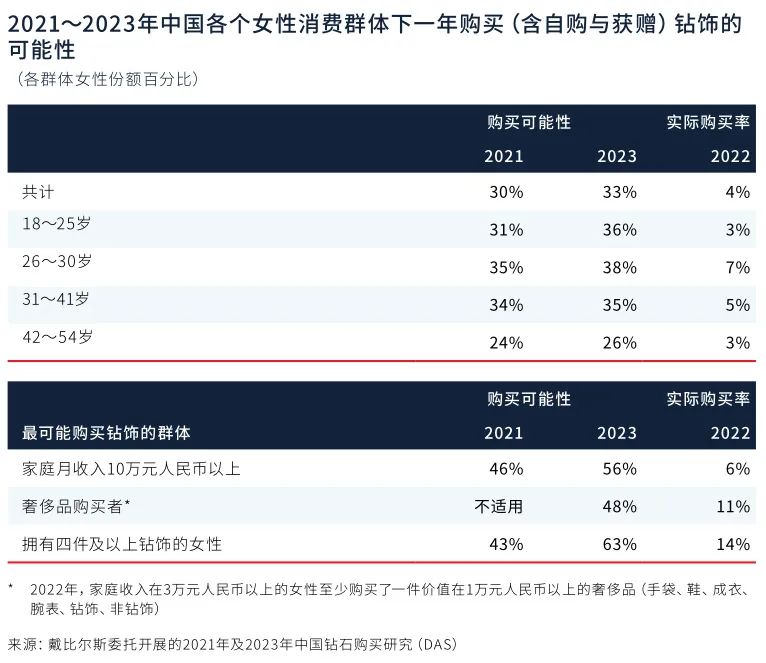
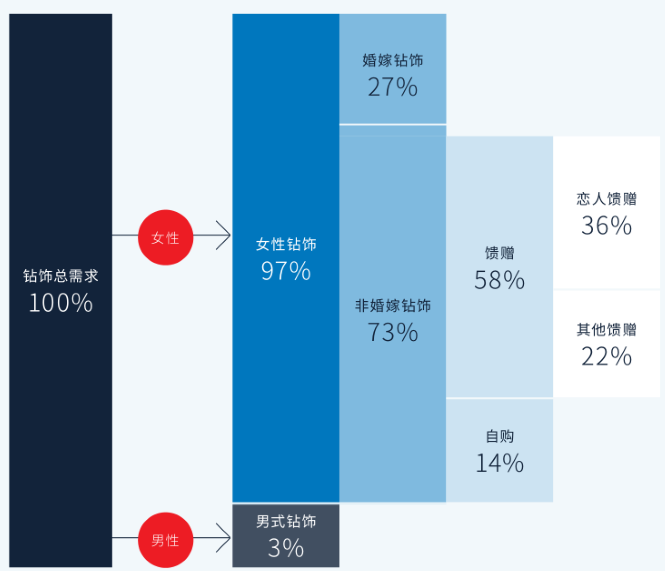
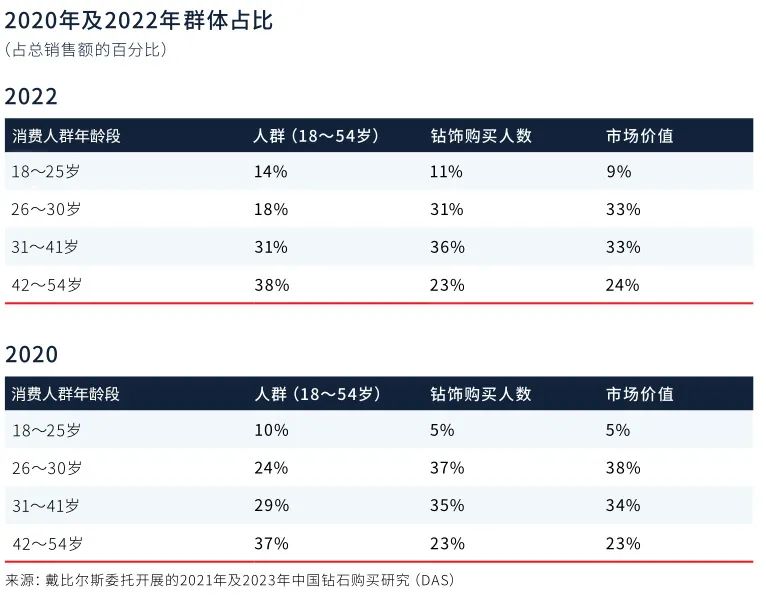
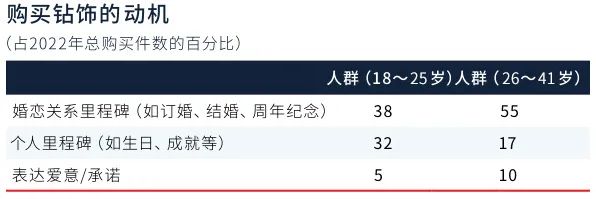
Figure 3 shows that the 26-41-year-old group is the core of China’s diamond consumption, accounting for 49% of respondents, accounting for 67% of consumers, and contributing 66% of consumption. The 18-25-year-old group has grown significantly, and its consumption power has gradually matched its population proportion, indicating future potential. In the short term, 26-41 year olds will firmly occupy the market base; in the long term, 18-25 year olds will gradually become mainstream. The wedding market is dominated by people aged 26-30, who prefer clarity, size and price; those aged 31-41, who prefer size, clarity and price. 18-25 year olds are more concerned about brand ethics and social responsibility, 65% consider brand image, and prefer online search and purchase, which is twice that of older people, but their purchasing power is still limited. This age group prefers non-wedding commemorative consumption, pushing brands to expand market boundaries.
Significant trends show that consumers attach more importance to brands. Between 2016 and 2022, the market share of well-known brand diamond jewelry jumped from 44% to 92%, highlighting the trend of consumers seeking brand values and emotional resonance.

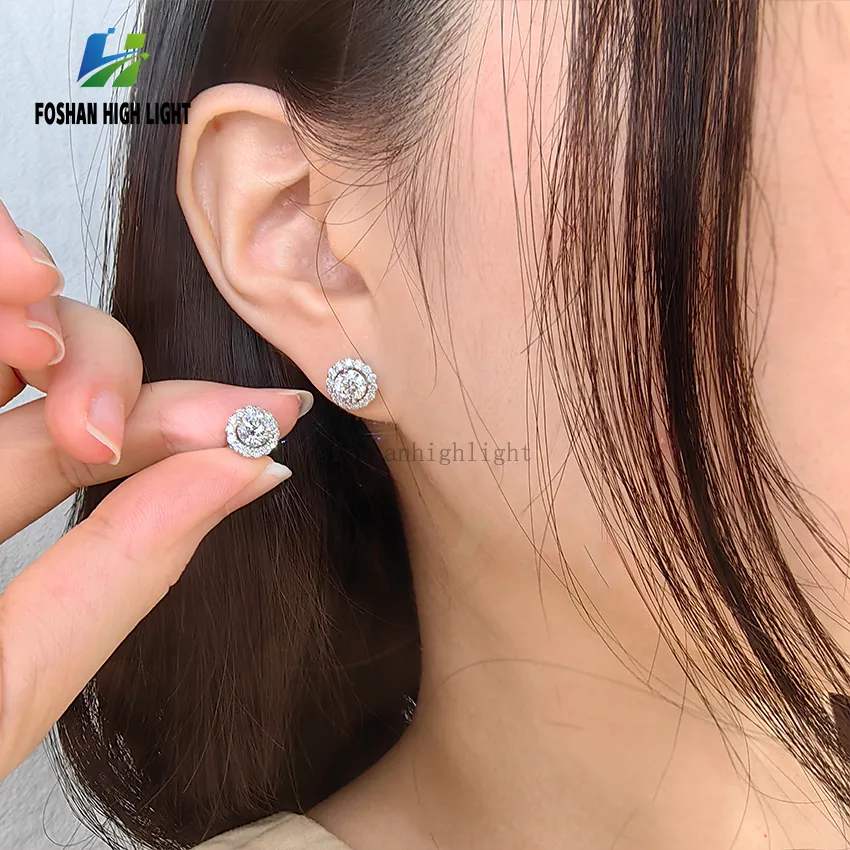
In recent years, the diamond industry has faced multiple challenges in terms of economy, supply chain and values, but this is not the first time it has experienced a market downturn. As the cornerstone of the jewelry industry, diamonds have a solid foundation. We need to remain optimistic, overcome difficulties together, and wait for the market to pick up.









-

Single-Crystal vs Polycrystalline CVD Diamond: Process Difference Lies in Growth Logic, Not Equipment
The process difference between single crystal and polycrystalline CVD diamond lies not in equipment, but in growth logic. Single crystal and polycrystalline CVD diamond are two functional new materials with completely independent growth mechanisms, lattice structures and performance systems. Their process logic, product features and application boundaries diverge fundamentally from the very start of deposition and growth. Comparing or selecting materials without considering their underlying crys
-
From Lab-Grown Diamonds to Industrial Diamonds: Is It Time to Build an MPCVD Factory?
The lab-grown diamond industry is entering a new stage. Over the these few years, lab-grown diamonds have gradually gained wider acceptance in the jewelry market. With the development of production technology, equipment maturity and supply chain improvement, the industry is becoming more standardized and efficient. But beyond jewelry, another opportunity is attracting more attention:Industrial diamond applications.
-
Diamond‑Copper Composite: A Next‑Generation Solution for High‑Power Electronics Thermal Management
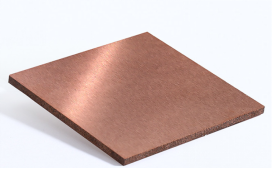
Diamond‑copper composite (DC) is an advanced metal‑matrix composite material consisting of diamond particles as the reinforcement phase and copper as the matrix, fabricated through state‑of‑the‑art composite preparation techniques. Diamond has the highest thermal conductivity of any naturally occurring material, with isotropic values ranging from 1200 to 2300 W/m·K. Copper, with a thermal conductivity of 401 W/m·K, ranks second only to silver among common metals. By combining the two, the compo
-
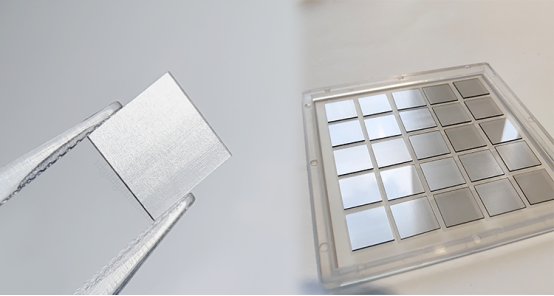
Mosaic Single‑Crystal Diamond: Breaking Size Limits
With an ultra‑wide bandgap of 5.47 eV, ultra‑high thermal conductivity (>2000 W/m·K), high carrier mobility (electron mobility up to 4500 cm²·V⁻¹·s⁻¹), and ultra‑high theoretical breakdown field strength (>10 MV/cm), Single‑Crystal Diamond (SCD) is an ideal candidate for next‑generation high‑power, high‑frequency and extreme‑environment electronic devices. However, both natural diamond and HPHT‑synthesized single‑crystal diamond are limited in lateral size, which greatly hinders large‑scal